The Layers Are the Subject
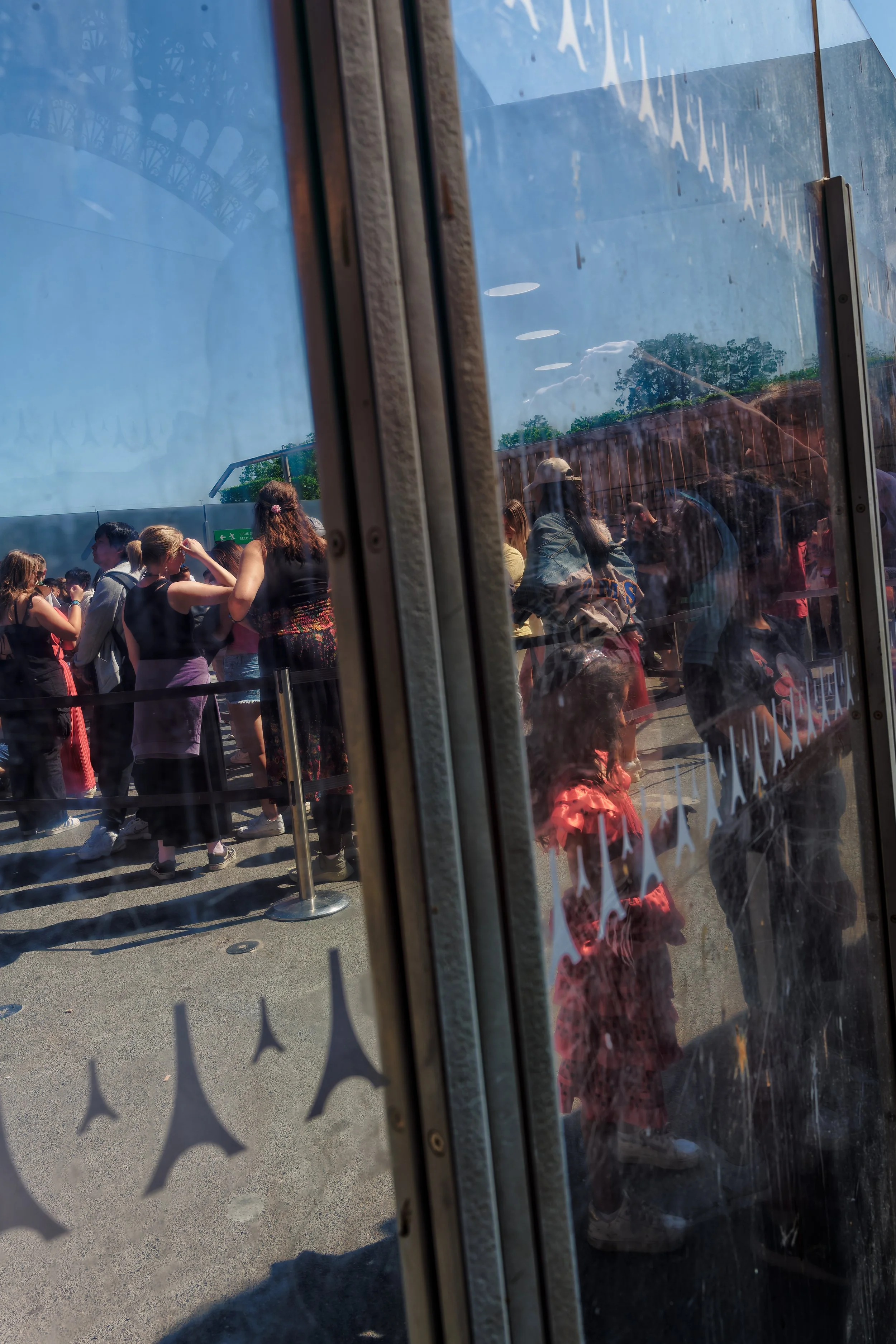
When we encounter a scene, we rarely see only one thing.
Our attention moves. A flash of color catches us first. Then a face. A gesture. Something behind glass. A reflection that initially seemed unimportant. And sometimes, only after looking for a while, we discover something that had been there all along.
That is how I experience the world with a camera.
In this photograph, my eye first goes to the red-dressed figure in the lower right. From there, it moves into the crowd and across the glass, where figures, reflections, structure, and fragments of the scene begin to overlap. Only then do I notice the faint reflection of the Eiffel Tower hovering in the upper left.
Had the Eiffel Tower been immediately obvious, the photograph would have become about the Eiffel Tower. But here it is only one element among many—Paris revealed gradually rather than announced.
That matters to me.
I am increasingly drawn to photographs that resist reducing a scene to a single subject. Glass may hold the street and the interior at the same time. Reflections can place strangers beside one another who never actually shared the same space. Color can connect distant parts of the frame. A familiar landmark can become little more than an apparition.
These are not distractions from the subject.
The layers are the subject.
We live in a visually complicated world. Foreground and background coexist. People pass behind and through reflections. Signs, architecture, gestures, light, color, and memory compete for our attention. Our eyes move among them, continually deciding what matters and discovering relationships that may exist for only a fraction of a second.
I do not want photography to simplify that experience too much.
I want the viewer to enter the frame, move through it, discover something, reconsider it, and perhaps find something else on a second or third look.
For me, that process of discovery is very close to what seeing actually feels like.
And increasingly, it is what I want my photographs to be about.